
Sports tech

Global Fan.

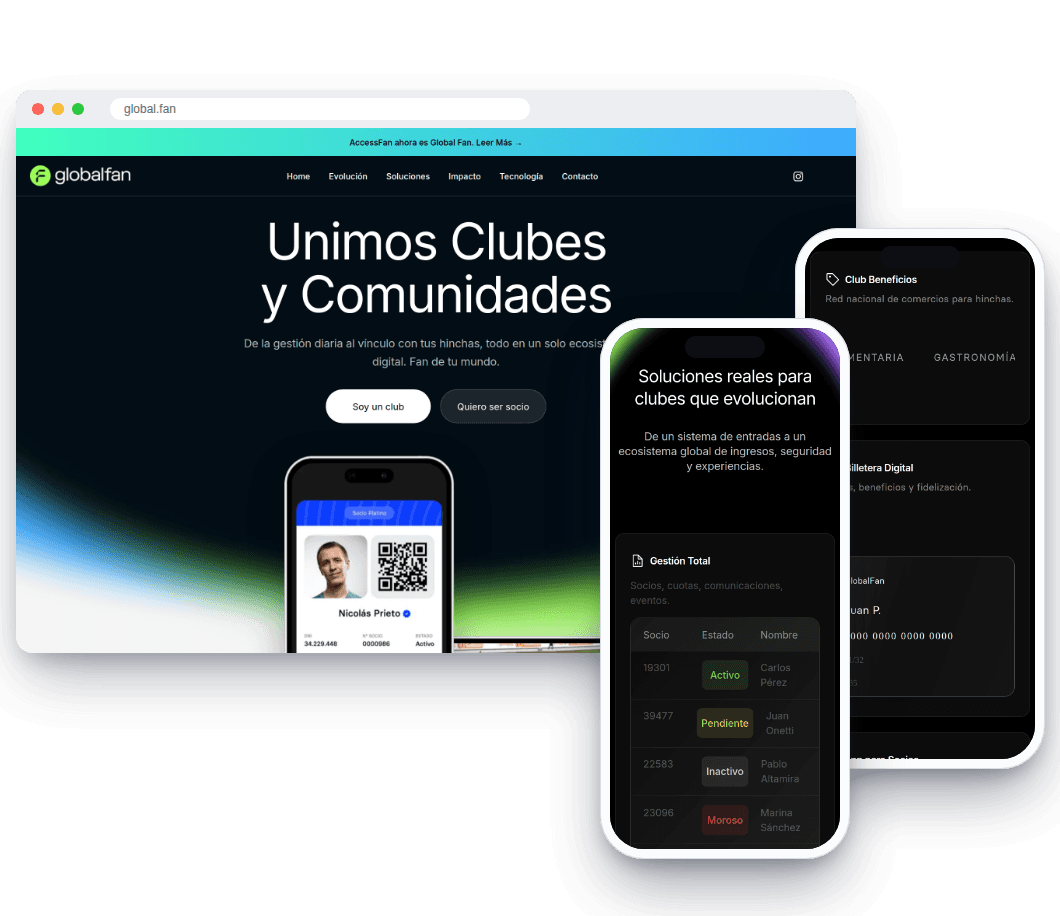
Since 2019 we have designed, built and operated the digital ecosystem that 130+ sports clubs in Argentina use to manage members, sell tickets and control stadium entry with facial recognition.

Since
2019
Role
Product · Engineering · Cloud
Reach
14 provinces
Visit site →
Global Fan screenshots on desktop and mobile
  • 130+
    clubs in 14 provinces
  • 3M+
    tickets sold
  • 20M+
    identity validations
  • 250k+
    active users

The challenge

Clubs managed members, dues and tickets with spreadsheets, disconnected systems and manual checks at the gate. That meant scalping, identity fraud, long queues and little insight into their own fans.

The technical problem is extreme by nature: traffic is almost flat during the week and multiplies within minutes when sales open for a big match or when thousands of fans reach the stadium at once. Every ticket must be sold exactly once and every entry must be validated in seconds, even when connectivity fails.

What we built

  • Members and dues

    Multi-club member registry, automatic debit and multiple payment methods, with e-invoicing and accounting integration.

  • Ticketing

    Online sales with exact capacity, numbered seats and dynamic QR tickets, designed to absorb the rush when sales open.

  • FaceID access

    Identity validation with liveness detection and national ID registry checks, integrated with stadium turnstiles for paperless entry.

  • Offline operation

    Turnstiles and scanners keep validating from local lists if connectivity drops at the stadium.

  • Wallet and perks

    Digital wallet and a fan benefits network with partner merchants, inside the members app.

  • Multi-tenant

    Each club's data is isolated in its own schema, on a single platform that ships updates to everyone at once.

Scaling for match day

In 2023 we moved the platform to Kubernetes on AWS. The API now scales on its own: during a top-division match with 29,036 entries it went from 10 to 37 instances with no manual intervention, served 3.3 million requests in just over four hours with 99.999% successful responses, and the database never went above 23% CPU.

During the most demanding ticket sale openings the platform went past 74,000 requests per minute (over 1,200 per second) with more than 120 API instances running in parallel.

  • Exact capacity under a rush

    We replaced the capacity check with an atomic counter in the database. Load tests with 6,519 simultaneous redemptions: zero overselling, errors from 638 to 0 and database CPU from 95% to 56%.

  • Autoscaling that reacts in time

    We redesigned health checks so new instances come into service under load: from 20 to 90 ready instances, p95 from 19.8 s to 5.2 s and 4x throughput.

  • Database connections

    We added a per-node connection pooler: from 660 to 199 connections in the same rush, with no out-of-memory kills and the same latency.

  • Fewer queries per request

    We optimized tenant switching between clubs: the busiest screens went from 136 to 45 queries per request.

  • PostgreSQL 13 → 18

    We upgraded a 70 GB database with more than 42,000 tables in 56 minutes of total downtime. The entry scanner query now plans 5.7x faster.

  • Queues that scale on demand

    Background workers scale on queue size and latency instead of CPU, draining spikes of thousands of pending jobs.

The journey

  1. 2019

    AccessFan is born

    First version to digitize fans' access to the stadium.

  2. 2020 – 2022

    Multi-club platform

    API and web app for member management, online payments and the first QR tickets.

  3. 2023

    FaceID, offline mode and Kubernetes

    Facial recognition with liveness detection, scanners that work offline and a move to Kubernetes with autoscaling.

  4. 2024

    Identity and invoicing

    National ID registry validation, e-invoicing and integration with access control hardware.

  5. 2025

    Global Fan

    Digital wallet, benefits network, numbered seating and the rebrand from AccessFan to Global Fan.

  6. 2026

    Ready for the next scale

    Rails 8, PostgreSQL 18, connection pooling and demand-based queue autoscaling.

Tech stack

  • Ruby on Rails
  • GraphQL
  • Next.js
  • React
  • PostgreSQL
  • PgBouncer
  • Redis
  • Sidekiq
  • AWS
  • Kubernetes (EKS)
  • Karpenter
  • KEDA
  • AWS Rekognition
  • Cloudflare
  • Prometheus
  • Grafana
  • New Relic
  • GitLab CI

Let's talk

At Coding Ways, we're more than just a software development company – we're your partner in success. Contact us today to learn more about our services and how we can help you transform your ideas into reality.